If you plan to study, work, migrate, or transact abroad, you’ll likely be asked for an apostille on your Indian documents. This guide from VerifiedApostille breaks down the meaning, the Indian process (Sticker and e-Apostille QR), and how to pick the right route.
1) What is an apostille?
An apostille is an internationally recognized certificate of authenticity issued under the Hague Convention of 5 October 1961. It confirms a public document’s origin so it can be used in Hague Convention countries without further consular legalization.
- Indian authority: the Ministry of External Affairs (MEA).
- Where it works: Hague member countries; for non-members, use embassy attestation.
2) Why is it required?
Authorities abroad want confidence that your document (degree, birth/marriage certificate, PCC, POA, invoices, etc.) is genuine. The apostille aligns verification standards so recipients can trust the issuing country’s signatures and seals.
3) What does an apostille look like?
India issues:
- A Sticker apostille (physical label affixed to the document), and
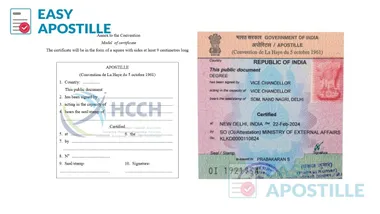
- An e-Apostille (QR) — a digitally signed certificate with a QR code for online verification.
Typical fields include the Hague title, country, signer’s name/capacity, seal, date/number, and issuing authority details.
4) Apostille vs. Attestation (what’s the difference?)
“Apostille” applies to Hague members; “Attestation” (legalization) applies to non-Hague countries via their embassy/consulate.
| Feature | Apostille | Embassy Attestation |
|---|---|---|
| Destination | Hague Convention members | Non-Hague countries |
| India authority | MEA (Sticker / e-Apostille QR) | Embassy/Consulate after MEA |
| Typical speed | Faster (often 1–3 working days) | Longer (varies by mission) |
| Extra consular step | Not needed | Required |

If your destination is in the Hague list, you need an apostille—not embassy attestation.
See: Hague vs Non-Hague .
5) India routes at a glance (education • personal • business)
Your route depends on the document category and the recipient’s checklist:
-
Education (Degree, Marksheet, TC):
Notary → SDM or HRD/Education → MEA (Sticker / e-Apostille).
Start here: Education Apostille -
Personal (Birth, Marriage, PCC, Affidavits):
Notary → SDM/State Home → MEA.
See: Personal Apostille -
Business / Commercial (POA, MOA/AOA, Incorporation, Invoices):
Notary → Chamber of Commerce (CoC) → MEA.
Details: Business Document Apostille
Choose Sticker if the authority insists on a physical label or in-person verification.
Choose e-Apostille (QR) when the destination accepts digital verification—faster sharing, easy re-use.
6) Step-by-step: How to get an apostille in India
A) Sticker Apostille (physical)
- Eligibility & route (SDM/Home/HRD/CoC as applicable).
- Pre-auth (Notary → SDM/HRD/CoC).
- MEA applies the sticker and returns the document.
- Delivery: tracked courier (India & abroad).
Guide: Apostille in India — Step-by-Step
B) e-Apostille (QR)
- Confirm acceptance by your recipient/country.
- Use the official e-Sanad flow where supported (some institutions require prior verification).
- Receive a digitally signed e-Apostille PDF with QR.
Guide: Get QR/e-Apostille Online
7) Costs & timelines — what to expect
- MEA fee is low; total cost changes with pre-auth (SDM/HRD/CoC), translations, page count (business docs), and courier.
- Typical timelines (after acceptance): many SDM/CoC routes finish in ~2–3 working days; HRD/university checks can add time.
Full breakdown: Apostille Price in India
Original vs copy guidance: Original vs Copy
8) What you usually need
- The document (original or scan, as permitted by route)
- Passport copy (ID page; both spouses for marriage)
- Any pre-verification (HRD / Home / SDM / CoC) the recipient demands
- Translations / affidavits when names or languages don’t match requirements
Frequently Asked Questions
Who issues apostilles in India?
The MEA (Ministry of External Affairs) issues apostilles, including e-Apostille (QR).
Do apostilles expire?
No. But many evaluators ask for recently issued documents (often within 6–12 months).
Is notarization enough by itself?
No. Notarization is a local act. Apostille is the international authentication for Hague members.
My country isn’t in the Hague list—now what?
Use embassy/consulate attestation after MEA. See the non-Hague flow here:
Hague vs Non-Hague .
Next steps with VerifiedApostille
- Personal: Birth, Marriage, PCC & Affidavits
- Education: Degrees, Marksheets, TC
- Business: POA, MOA/AOA, Incorporation, Invoices
Prefer WhatsApp? Start a chat from Contact — we’ll share a written route, all-inclusive quote, and ETA.
