

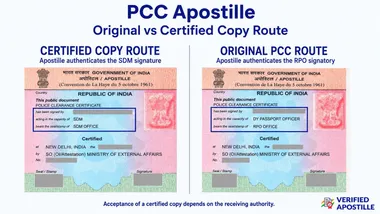
An Indian Police Clearance Certificate can reach the MEA apostille stage through the original PCC or, where the case and recipient permit it, through a properly certified copy made from a scan. Both may produce a valid apostille, but they do not authenticate the same official act.
First identify which PCC you hold: an Indian Embassy or Consulate PCC, an RPO/Passport Seva PCC, a local police or Commissioner PCC, or a District Police/FRRO PCC for a foreign national. The issuing authority affects the available authentication route. See our guide to the types of Indian Police Clearance Certificates before choosing original or copy processing.

Choose the original PCC route when the receiving authority needs the apostille to identify the RPO signer and Regional Passport Office seal. A certified scan-copy route can be practical when a certified copy is accepted, but its apostille normally identifies the SDM who certified the copy—not the RPO officer who signed the PCC.
Original PCC vs scan-copy route at a glance
| Point | Original PCC route | Certified scan-copy route |
|---|---|---|
| Document handled | The physical PCC issued and signed by the Passport Authority or other PCC issuer | A copy produced from the scan and properly certified through the applicable notarial/SDM process |
| Signature authenticated by the apostille | The recognized signature on the original PCC | The signature of the SDM or other public official who certifies the copy |
| Name and capacity commonly shown | RPO/Passport Authority officer and that officer’s official capacity | SDM or other certifying officer and that officer’s official capacity |
| Seal commonly described | The Regional Passport Office or issuing authority seal | The SDM or certifying authority seal |
| Best choice when | The recipient requests the original or wants the RPO name/seal reflected in the apostille | The recipient expressly accepts a certified copy and sending the original is unnecessary or impractical |
Route 1: Apostille on the original PCC
With the original route, the physical PCC is checked and processed according to its issuing authority and recognized signature. The apostille is attached to the original document or its allonge and identifies the public signature, the signer’s capacity and the seal or stamp authenticated.
In the anonymized Cochin example below, the PCC itself bears the Regional Passport Office seal and the signature of a Deputy Passport Officer. The MEA apostille is placed on the same original PCC and records that recognized public signature, capacity and office seal.
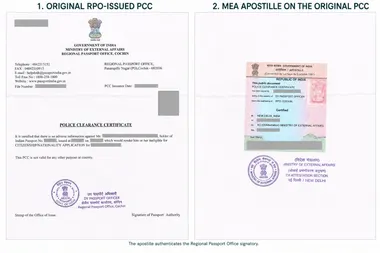
The corresponding apostille fields identify the public document as a Police Clearance Certificate, the signer’s capacity as Deputy Passport Officer, and the seal or stamp as RPO, Cochin. Names, capacities and seals are case-specific and must be taken from the PCC and the competent authority’s current signature records — use the RPO PCC apostille office finder to check whether your issuing office is on MEA’s current list.
When the original route is necessary
Use the original certificate when the foreign authority, immigration case officer, employer or licensing body:
- expressly asks for the original PCC;
- asks for an apostille connected to the RPO signer’s name;
- expects the Regional Passport Office seal to be described;
- will not accept a notarized or certified copy; or
- requires the original for its own document-verification process.

If the recipient specifically asks for the apostille to show the RPO officer’s name or the Regional Passport Office stamp, process the original PCC. A scan-copy route normally changes the public official authenticated by the apostille to the SDM or other certifying officer.
Route 2: Apostille through a certified scan copy
“Scan-copy apostille” is convenient shorthand, but it can be misleading. An ordinary printout of a scan is not sent directly to MEA as though it were the original. The copy must first be notarized or certified through the applicable route so that it becomes a public document capable of authentication.
MEA’s current procedure says the original document or a true copy is submitted through an authorized outsourced service provider, and it expressly states that MEA does not legalize photocopies. See the MEA Attestation/Apostille procedure.
In an anonymized certified-copy example, the reproduction should show the RPO-issued PCC together with the notarial certification, SDM attestation and MEA apostille. The apostille fields identify the SDM or other recognized certifying officer, that officer’s capacity, and the SDM office seal—not the original RPO signatory as the authenticated signature.
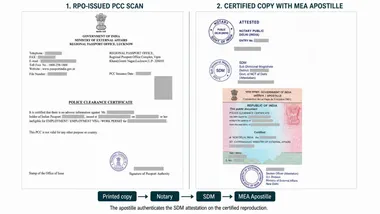
Here, “signed by” in the apostille refers to the certifying public act used for the copy route. It does not mean that the SDM originally issued the police-clearance result. The PCC remains visible in the certified reproduction, but the apostille authenticates the SDM’s signature, capacity and seal.
Are both accepted in Hague countries?
Both routes can operate under the Apostille Convention when:
- the route results in a valid Indian public document;
- the apostille is issued by the competent Indian authority;
- the Apostille Convention is in force between India and the destination; and
- the recipient accepts that PCC issuer, document age and original-or-certified-copy format.
The Convention removes the traditional legalization requirement for covered foreign public documents. It does not force a recipient to accept the underlying document’s content, an old PCC, the wrong issuing authority or a certified copy where its rules require the original. The HCCH Apostille Convention text explains that it applies to public documents executed in one Contracting State and produced in another.
Check the destination in our Hague Apostille country checker, then obtain the receiving authority’s written document requirement.
Based on recent client experience, South Korea immigration offices have accepted an MEA apostille on both the original PCC and a certified scan-copy PCC. In one recent case, a client’s certified-copy apostille was couriered by DHL to Busan, South Korea, and used for a visa application. Acceptance is still decided case-by-case by the receiving office, so confirm the written requirement before choosing a route.
What an apostille does—and does not—confirm
An apostille confirms the origin of a public document. Its standard fields identify matters such as:
- who signed the public document;
- the capacity in which that person acted; and
- the seal or stamp borne by the public document.
It does not confirm that the police-clearance result is substantively correct, that a certified copy will be accepted for a particular visa, or that the PCC is recent enough. MEA likewise states that it legalizes documents based on recognized signatures and does not take responsibility for their contents.
Which route should you choose?
Choose the original PCC route if any requirement mentions the original, RPO signer, Passport Authority, or Regional Passport Office seal. Choose the certified scan-copy route only after the recipient confirms that it accepts a certified copy and you understand that the apostille will identify the certifying official, commonly the SDM.
Before processing, send a complete, clear scan of the front and reverse of the PCC together with the destination country and the recipient’s written checklist. The route should be confirmed before the original is couriered or a certified copy is prepared — applying from outside India? Our guide to getting a PCC apostille without visiting India covers secure courier and representative options. Once the route is confirmed, our PCC apostille service handles pickup, MEA filing, and worldwide return.

Send your PCC scan and we’ll confirm original vs scan-copy route, price, and ETA the same day.
Frequently asked questions
PCC apostille original vs scan copy FAQs
Is an apostille on the original PCC different from one obtained through a scan-copy route?
Yes. On the original route, the apostille can identify the RPO or Passport Authority officer whose signature and seal appear on the PCC. In a properly certified-copy route, the apostille normally identifies the SDM or other public official who certified the copy. The apostille therefore authenticates a different signature and capacity.
Are both PCC apostille routes acceptable in Hague Convention countries?
Both can be used under the Apostille Convention when each route produces a valid public document and the Convention is in force between India and the destination. Acceptance of the PCC's content, age, issuer and original-or-copy format remains with the receiving authority, so confirm its written requirement first.
Will the RPO officer's name appear when a PCC scan copy is apostilled?
Usually not. In a certified scan-copy route, the apostille generally records the SDM or other certifying officer's name, capacity and seal. If the recipient specifically requires the RPO signer's name or Regional Passport Office seal on the apostille, use the original PCC route after document review.
Can an ordinary photocopy or printout be sent directly to MEA for apostille?
No. MEA states that it does not legalize photocopies. A scan-based route must first create a properly notarized or certified public document through the applicable process; it is not the same as submitting an uncertified printout.
Does an apostille verify the police-clearance result?
No. An apostille authenticates the origin of the public document, such as the signature, official capacity and seal. It does not verify the truth of the PCC's contents or extend the PCC's validity period.
Customer Reviews
The process to get apostille was fast and smooth. I got the certificate faster and could finish visa work. Thank you for your efforts.
- Clear process
- Fast turnaround
- Secure delivery
- Good communication
The apostille service is really fast and easy. They communicate very well and professionally, specifically Mr. Prabhakaran is really helpful.
- Fast and easy service
- Professional communication
- Helpful support
