
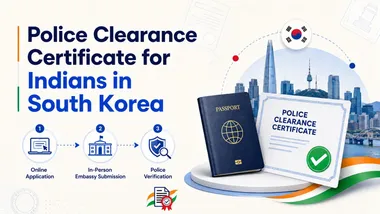
Indian nationals living in South Korea can apply for an Indian Police Clearance Certificate through the Du Digital Global Indian Consular Application Centre (ICAC) — the current outsourced service centre handling PCC applications on behalf of the Embassy of India, Seoul. Foreign nationals who previously lived in India for work, study, or residency can also apply, for the period they were in India.

They are different documents. Confirm whether Korean Immigration, an employer or another authority requires an Indian PCC, a Korean police certificate, or both.
Official requirements checked: 31 August 2026. Always recheck the Du Digital ICAC Police Clearance Certificate page and the Embassy of India Seoul consular information before applying.
Who can use this process?
This guide covers two groups applying while based in South Korea:
- Indian passport holders who need a PCC for immigration, residential status, employment, a long-term visa, or another accepted official purpose.
- Foreign nationals now in South Korea who previously lived in India for work, study, or residency, and need a PCC covering that specific period.
An Embassy/ICAC-issued PCC is one of several Indian PCC routes — if you’re weighing this against an RPO or police-issued certificate, see our comparison of Indian PCC issuing authorities.
The MEA states that PCC is issued to Indian passport holders for residential status, employment, long-term visas or immigration and not for travel on a tourist visa. See the MEA PCC guidance.
When is a PCC required in South Korea?
A Police Clearance Certificate is a common supporting document for Korean visa categories that lead to long-term residence, most notably:
- F-2 visa (long-term resident/points-based status)
- F-5 visa (permanent residency)
Korean Immigration decides the exact requirement for your case, so confirm the current checklist with your immigration office or case handler rather than assuming a PCC is needed for every F-2 or F-5 application.
Two ways to get an Indian PCC while in South Korea
- Route 1 — Apply through Du Digital ICAC, the current authorized centre working on behalf of the Embassy of India, Seoul. Covered step-by-step below.
- Route 2 — Apply directly through your Regional Passport Office (RPO) in India, the one tied to your last Indian address. This needs an in-person interview at that RPO, so it suits applicants who can travel to India or are already planning to.
Both routes end the same way — Indian police verification of your last known address, followed by certificate issue. VerifiedApostille apostilles PCCs obtained through either route.
Route 1: Applying through Du Digital ICAC
- Register on the Du Digital ICAC portal for South Korea.
- Submit the government PCC application through the official Passport Seva mission portal, selecting the PCC service.
- Book an ICAC appointment for a date and time that works for you.
- Prepare your documents — see the checklist below.
- Visit Du Digital ICAC, arriving about 15 minutes early. Du Digital has since introduced a postal application option too — you complete part of the process online and post your original documents to them, if visiting in person isn’t practical.
- Submit your application. Bring everything on the checklist — a missing document means it can’t be processed that day, though ICAC may separately request additional documents later if needed.
- Foreign nationals only: ICAC arranges your Embassy interview, held Friday mornings (10:00 AM – 12:30 PM), on a first-scheduled, first-served basis.
- Track your application online once it’s submitted.
A couple of practical notes from applicants who’ve been through this:
- The request letter isn’t a fixed template — ICAC will tell you what details to include; write it to match their instructions rather than a generic format.
- If you don’t have a compliant 2×2 inch photo ready, ICAC can take one on the spot at no extra charge — still worth dressing smart and being camera-ready just in case, since bringing your own is faster.
Documents checklist
For Indian nationals
- Printout of your online-submitted PCC application (Passport Seva mission portal)
- Personal Particulars form and Miscellaneous Application form — ICAC provides these and guides you through filling them
- A request letter covering your purpose, passport details, and Korean contact details
- Original passport, with copies of the first, second, and last pages
- Original and copy of your Alien Registration Card (ARC)
- Two recent 2×2 inch passport photos (white background), plus a digital copy
For foreign nationals (Embassy interview required)
- A request letter covering your purpose, the period of stay in India you need covered, passport details, and Korean contact details
- Copies of passport stamps showing your first arrival and last departure from India
- Copies of your Indian visas
- Copy of your FRRO card or residence permit
- Proof of your residence or stay in India — education certificates, employment letters, rental agreements, or similar
- A fingerprint card, taken at a local Indian police station per Indian authority requirements
- Original passport, with copies of the first, second, and last pages
- Original and copy of your Korean ID or Alien Registration Card
- Two recent 2×2 inch passport photos (white background)
How the police verification actually plays out
Once your application reaches the Embassy, here’s roughly what happens behind the scenes:
- The Embassy forwards your case to the Regional Passport Office (RPO) in India covering your last Indian address.
- The RPO raises a verification request with the local police station for that address — depending on the station, you may need to visit in person or wait for a call. Which of the two applies affects how quickly the response comes back.
- You can track progress two ways: Du Digital’s own tracker, which typically shows only a generic “under processing” status, and the RPO’s own application-tracking page, which is usually more specific — showing stages like “police verification initiated” or “notice sent to Indian Consulate.”
- Once the Consulate receives the police clearance, it issues the certificate and posts it to your home address in South Korea — Du Digital updates your status once it’s dispatched.
If you want a clearer read on where things stand, it’s worth checking the RPO tracker alongside Du Digital’s.
Route 2: Applying directly through your RPO
If you’d rather skip the Embassy/Du Digital route, you can apply directly with the Regional Passport Office (RPO) tied to your last Indian address. The trade-off is that you — not a representative — need to attend that RPO in person for an interview. From there, the process is the same as Route 1: police verification of your address, followed by the RPO issuing your certificate directly.
This route can suit applicants who are already planning a trip to India, or who’d rather deal with the RPO directly than go through ICAC.
Fees and processing time
Du Digital ICAC accepts bank transfer, debit card, and credit card. Card payments carry a 2–3% processing surcharge, so a bank transfer is usually cheaper if it’s an option for you. Processing typically takes around 4 weeks, depending mainly on how quickly the police verification report comes back from India. Confirm the current fee before applying on the official Du Digital ICAC page — fees can change.
Does the Indian PCC need an apostille for South Korea?
India and the Republic of Korea participate in the Apostille Convention, but that does not mean every PCC submission automatically requires an apostille — the Korean recipient decides what it accepts. One thing stays fixed either way: Indian missions in South Korea do not apostille PCCs themselves. Apostille is a separate step, handled in India by the Ministry of External Affairs (MEA), regardless of whether your PCC came through Du Digital ICAC or directly from your RPO.
Based on recent client experience, a PCC issued by the Embassy of India, Seoul and apostilled through MEA is accepted by South Korea immigration offices — and both the original-document apostille route and a certified-copy apostille route have been accepted. In one recent case, the client’s PCC was apostilled through the certified-copy route and the apostilled document was couriered by DHL to Busan, South Korea for a visa application. Since acceptance is ultimately decided case-by-case by the immigration officer, still confirm the current requirement in writing before choosing a route.
Ask for written confirmation covering:
- apostille required or not required;
- original or copy;
- acceptable apostille format;
- Korean translation requirement;
- acceptable age of the PCC.
How to arrange the India apostille from South Korea

The ARN (Application Reference Number) generated when you submitted your PCC application is a mandatory part of the apostille verification — it is not optional paperwork. This is the ARN from the PCC application itself (the Passport Seva / Embassy application step), not any separate reference or tracking ID that Du Digital ICAC issues for your ICAC appointment or courier tracking. Keep the ARN page or confirmation alongside your PCC scan when you send it for route review.
Whichever route issued your PCC — Du Digital ICAC/Embassy or directly via your RPO — VerifiedApostille apostilles both:
- Send a complete scan of the PCC and recipient’s written checklist for route review.
- Confirm whether the original must travel to India.
- Use tracked international courier or an authorized person in India where permitted.
- Complete the confirmed India authentication and MEA apostille route.
- Review the completion scan.
- Receive the document back in South Korea by tracked delivery.
Read the general Indian PCC apostille from abroad guide or review current service details on the PCC apostille service page.
Common mistakes to avoid
- applying for an Indian PCC when the recipient actually wants a Korean police certificate;
- assuming the Embassy or Du Digital ICAC apostilles the PCC — neither does;
- missing the request letter or required forms;
- incorrect photograph dimensions or background;
- ignoring an Indian passport/address mismatch;
- forgetting to select a police station during the application — it’s mandatory;
- assuming police verification has a fixed completion date;
- paying by card without accounting for the 2–3% surcharge;
- translating or apostilling a PCC that contains an error;
- sending the original to India before confirming the apostille requirement;
- assuming a new apostille makes an old PCC recent;
- losing the PCC application ARN, or confusing it with Du Digital ICAC’s own reference/tracking number — the apostille verification needs the application ARN.
Frequently asked questions
Indian PCC from South Korea FAQs
Who can apply for an Indian PCC from South Korea?
Indian passport holders who need it for residency, employment, a long-term visa, or immigration — not for tourist travel. Foreign nationals who previously lived in India for work, study, or residency can also apply, for the specific period they were in India.
Do I need to visit Du Digital ICAC in person?
Usually yes, for document submission and identification. Du Digital has since introduced a partial-online option too — you complete part of the process online and post your original documents to them, if an in-person visit isn't practical.
Does the Embassy or Du Digital ICAC apostille the PCC?
No. Neither apostilles PCCs. Apostille is a separate step handled in India by the Ministry of External Affairs (MEA), regardless of whether your PCC came through Du Digital ICAC or directly from your RPO.
What language is the PCC issued in?
English only.
How long does an Indian PCC take in South Korea?
Typically around 4 weeks, mainly depending on how quickly the police verification report comes back from India. It can take longer if your last Indian address is unclear, outdated, or hard for local police to confirm.
Is there an age limit, and can minors apply?
There's no age limit for adult applicants. Minors can apply too, but only if a foreign government specifically requires a PCC for them.
Can I apply if my passport has expired?
No — a PCC is issued only against a passport valid for at least 6 months. Foreign nationals must separately meet the eligibility requirements: a valid passport, proof of address, and evidence of the exact period they resided in India.
What happens if I get an adverse police report?
A PCC can't be issued in that case. The most common causes are a mismatched address, gender, or name against your passport records. If this happens, you'll need to contact the concerned Indian police authority directly to resolve it.
Do I have to select a police station when applying?
Yes, it's mandatory — you select the station covering your last Indian address. If you're unsure which one, check your district's official police website or ask local contacts who'd know the jurisdiction.
Can I apply for a PCC more than once?
Yes. If your purpose or destination country changes, you may need to apply again for a fresh PCC covering the new requirement.
How do I track my PCC application?
Through the Passport Seva mission portal, and via Du Digital's own status page. The Regional Passport Office (RPO) tracker is often more specific than Du Digital's generic "under processing" status — it can show stages like police verification initiated or notice sent to the Indian Consulate.
Which South Korean visas commonly ask for a PCC?
A PCC is commonly requested for the F-2 (long-term resident) and F-5 (permanent residency) visa categories. Korean Immigration decides the exact requirement for your case, so confirm the current checklist with your case handler.
Is an Embassy-issued PCC apostille accepted by South Korea immigration?
Based on recent client experience, yes — a PCC issued by the Embassy of India, Seoul and apostilled through MEA has been accepted by South Korea immigration offices, on both the original-document apostille route and a certified-copy apostille route. Acceptance is still decided case-by-case, so confirm the written requirement first.
Do I need my PCC application ARN for the apostille?
Yes. The ARN generated when you submitted your PCC application is a mandatory part of the apostille verification. It's the ARN from the PCC application itself, not a separate reference or tracking number issued by Du Digital ICAC for your appointment or courier.
Next step after receiving the PCC
Whether your PCC came through Du Digital ICAC or directly from your RPO, send us the complete scan and your recipient’s written requirement before shipping the original — we’ll confirm the apostille route either way.

Send your PCC scan — from Du Digital ICAC or your RPO — and get your route, price, and ETA the same day.
Customer Reviews
The process to get apostille was fast and smooth. I got the certificate faster and could finish visa work. Thank you for your efforts.
- Clear process
- Fast turnaround
- Secure delivery
- Good communication
The apostille service is really fast and easy. They communicate very well and professionally, specifically Mr. Prabhakaran is really helpful.
- Fast and easy service
- Professional communication
- Helpful support
