
If you plan to study, work, migrate, or transact abroad, you’ll likely be asked for an apostille on your Indian documents. This guide from VerifiedApostille breaks down the meaning, the Indian process (Regular Stamp and e-Apostille QR), and how to pick the right route.
What an apostille means
An apostille is an internationally recognized certificate of authenticity issued under the Hague Convention of 5 October 1961. It confirms a public document’s origin so it can be used in Hague Convention countries without further consular legalization.
Use our tool to check if your destination is a Hague member: Check Hague Country - Apostille or Attestation Required.
- Indian authority: the Ministry of External Affairs (MEA).
- Where it works: Hague member countries; for non-members, use embassy attestation.

An apostille certifies only the signature or seal on your document and the capacity of the person or authority that signed or sealed it — it does not certify the content of the document itself, and it isn’t a grant of authority that adds weight to what’s written. It’s also strictly for use abroad: an apostille can never be used for recognition of a document in the country where it was issued, so an apostilled Indian document has no special standing for use within India.
An apostille stamp is the issuing country’s promise of authenticity.
Authorities abroad want confidence that your document (degree, birth/marriage certificate, PCC, POA, invoices, etc.) is genuine. The apostille aligns verification standards so recipients can trust the issuing country’s signatures and seals.
What does an apostille certificate look like?
India issues:
- A Regular Stamp apostille (physical stamp affixed to the document), and
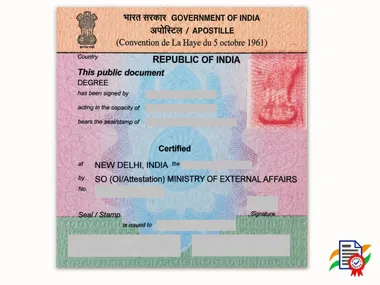
- An e-Apostille (QR) — the same physical stamp, with an added QR code and unique ID printed on it for online verification.
Typical fields include the Hague title, country, signer’s name/capacity, seal, date/number, and issuing authority details.
Apostille vs attestation: what’s the difference?
Yes — apostille and attestation are different processes for different destinations.
Apostille is for Hague Convention countries; attestation (legalization) is for non-Hague countries via their embassy/consulate located in the country where the document was issued.
If your destination is in the Hague list, you need an apostille—not embassy attestation.
Check your destination using our Apostille vs Attestation tool through Hague nation list.
Methods to get an apostille in India based on document type
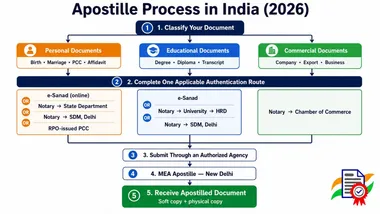
Your route depends on the document category and the recipient’s checklist:
-
Education (Degree, Marksheet, TC): e-Sanad online submission or Notary → SDM or HRD/Education → MEA (Regular Stamp / e-Apostille).
Start here: Education Apostille -
Personal (Birth, Marriage, PCC, Affidavits):
e-Sanad online submission or Notary → State Home or SDM → MEA. See: Personal Apostille
e-Sanad is the official Indian government portal for online verification and submission of certain documents for apostille. It can simplify the process for eligible educational and personal documents. But it is not fully matured yet for all states and document types — use our e-Sanad Document Issuing Authority (DIA) finder to check whether your board, university, or issuing office is currently integrated before assuming it is available.
- Business / Commercial (POA, MOA/AOA, Incorporation, Invoices):
Notary → Chamber of Commerce (CoC) → MEA.
Details: Business Document Apostille
Choose the Regular Stamp if the authority insists on physical-only or in-person verification.
Choose e-Apostille (QR) when the destination accepts online verification—faster sharing, easy re-use.
Step-by-step: How to get an apostille in India
Getting an apostille on a document in India as an overseas applicant is possible without traveling to India, in one of two ways: send the document to a family member in India to handle the process, or use an apostille agency like VerifiedApostille to manage the complete process on your behalf.
Share a scan of your document or original to handle Notary, SDM/HRD/CoC, and MEA submission on your behalf. The completed apostille is returned to your overseas address by international courier.
Note: MEA has outsourced document receipt and delivery to authorized centers since July 2012 — individuals can’t walk in and submit directly at the MEA counter, which is exactly the gap an agency or family member on the ground fills. See the full walk-in policy explanation for details.
You can choose regular stamp or e-Apostille (QR) based on your destination country’s acceptance.
Cost to get an apostille in India
MEA’s own fee is low; the total cost depends on which pre-authentication applies (SDM/HRD/CoC), translations, page count, and courier. Rough ranges by document category:
| Document category | Typical total cost |
|---|---|
| Personal (birth, marriage, PCC, affidavits) | ₹1,000–₹3,000 |
| Educational (degree, marksheet, TC) | ₹2,500–₹5,000 |
| Commercial (POA, MOA/AOA, invoices) | ₹3,000–₹6,000+ (scales with page count) |
Check our VerifiedApostille price list for full details.
- Typical timelines (after acceptance): many SDM/CoC routes finish in ~1-3 working days; HRD/university checks can add time. Finally, MEA processing is usually 1-2 working days for a regular stamp or 1-3 working days for e-Apostille (QR). Delivery: in India, 1-2 working days by Blue Dart, DTDC, or India Post courier; for international delivery, timing depends on the courier and destination — typically 2-5 working days. We prefer DHL, FedEx, UPS, or India Post for international delivery.
Common mistakes that delay or reject your apostille
- Lamination — a laminated document is often rejected outright, since authorities need to check the paper/seal directly. Never laminate a document you plan to apostille.
- Name or spelling mismatches — even a minor mismatch between your passport, ID, and the document being apostilled can trigger rejection; get an affidavit first if names or dates don’t match exactly.
- Skipping the mandatory pre-authentication step — MEA won’t apostille a document that hasn’t cleared the required Notary → SDM/HRD/CoC step first, based on document category.
- Using an expired or soon-to-expire supporting document — PCCs and similar personal documents have a limited validity window; apostilling too late can mean starting over.
- Choosing an unverified agent — since MEA only accepts submissions through authorized centers, working with an unreliable agent can mean lost documents or no recourse if something goes wrong.
The mistakes above are on the applicant’s side, before MEA issues the apostille. Once you have a genuine apostille, a receiving authority abroad can lawfully refuse to recognize it for only two reasons under the Hague Convention: its origin can’t be verified, or its format differs radically from the Convention’s Model Certificate. Cosmetic differences — how it looks, how it was affixed, extra text outside the standard fields — are not valid grounds for rejection. See the full breakdown in e-Apostille (QR) & e-Sanad Verification.
What you usually need
- The document (original or scan, as permitted by route)
- KYC documents for the applicant (passport, Aadhaar, PAN, etc.)
- Any pre-verification (HRD / Home / SDM / CoC) the recipient demands: 2 photos, reason for apostille, and any supporting documents
- Translations / affidavits when names or languages don’t match requirements
Frequently asked questions
Apostille in India FAQs
Who issues apostilles in India?
The Ministry of External Affairs (MEA) issues apostilles in India, including the e-Apostille (QR).
How much does an apostille cost?
MEA's official fee is modest (₹50–₹90 per document). Your total cost depends on pre-authentication (Notary/SDM/HRD), translations, and courier.
Do apostilles expire?
No — the apostille itself never expires, though some evaluators prefer documents apostilled recently (often within 6–12 months).
Is notarization enough by itself?
No. Notarization is a local act that verifies signatures or copies; an apostille is the international authentication recognized by Hague Convention members.
My country isn't in the Hague list — now what?
You'll need embassy or consulate attestation (legalization) instead of an apostille — typically Notary → State/SDM → MEA → Embassy.
What documents are eligible for an apostille in India?
Personal documents (birth, marriage, PCC, affidavits), educational documents (degree, marksheet, transcript), and commercial documents (POA, MOA/AOA, incorporation certificate, invoices) can all be apostilled, provided they're first notarized or issued by a recognized authority.
Can I apply for an apostille fully online in India?
Partly. e-Sanad lets you submit certain educational and personal documents online, but it isn't available for every state or document type yet, and physical pre-authentication or courier is often still required. Check e-Sanad's coverage for your specific document before assuming the whole process can be done online.
Does an apostille verify what's written in my document?
No. An apostille only certifies the authenticity of the signature or seal on your document and the capacity of the signing authority — it does not certify the content of the document, and it isn't a grant of authority that adds weight to what the document says.
Can I use my apostilled Indian document within India?
No. An apostille is strictly for use abroad — it can never be used for recognition of a document in the country where it was issued. An apostilled Indian document has no special legal standing for domestic use in India; it's the international authentication step for using that document overseas.
Next steps with VerifiedApostille
- Personal: Birth, Marriage, PCC & Affidavits
- Education: Degrees, Marksheets, TC
- Business: POA, MOA/AOA, Incorporation, Invoices
If you’re an Indian living in South Korea, your apostilled documents likely also need a Korean translation and/or notarization before a local office like NHIS will accept them. See our NHIS health insurance guide for Indian families and Family Relationship Certificate guide for Indians in South Korea.
Prefer WhatsApp? Start a chat on WhatsApp, or reach us via Contact — we’ll share a written route, all-inclusive quote, and ETA.
