
Short answer: Indians living in South Korea get a Family Relationship Certificate (FRC) through the India Consular Application Centre (ICAC) in Seoul, operated by DU Digital Global on behalf of the Embassy of India. It’s most commonly needed for NHIS health insurance dependent registration, along with dependent visas and similar submissions. Once issued, the certificate needs to go through four more steps before a Korean office will accept it: MEA apostille in India, a Korean translation, notarization of that translation (if your receiving office requires it), and submission to the relevant office — typically your local NHIS branch.

This page covers the South Korea-specific application process. For what a Family Relationship Certificate is, and how to get one if you’re not in Korea, see our general FRC guide for NRIs.
Official requirements checked: 3 September 2026. Always recheck the Du Digital ICAC Family Relation Certificate page and the Embassy of India Seoul ICAC page before applying, since fees and processing times can change.
Why Indians in South Korea specifically need an FRC
The most common trigger is NHIS (National Health Insurance Service) dependent registration — NHIS may ask for a Family Relationship Certificate rather than a marriage certificate when it needs to see your full family structure clearly, for example when children or multiple dependents are being registered together, or when reinstating coverage that lapsed. See our dedicated NHIS health insurance guide for Indian families for exactly which document applies to which NHIS scenario.
Beyond NHIS, an FRC issued in Korea can also support dependent visa/residence permit applications, school admissions for children, and other situations where a Korean office wants documented proof of your complete family structure.
How to apply: through ICAC Seoul (DU Digital Global)
Since June 2025, consular services for Indians in South Korea — including family relationship certificates — are handled through the India Consular Application Centre (ICAC), operated by DU Digital Global, on behalf of the Embassy of India in Seoul.
Step by step
- Register an account on the DU Digital ICAC portal for South Korea.
- Submit the government application form for the Family Relation Certificate service through the official MEA portal.
- Book an appointment for your visit to ICAC in Seoul.
- Gather your documents (see checklist below).
- Attend your appointment in person, arriving about 15 minutes early — personal attendance is required for the applicant.
- Pay the applicable fee. ICAC accepts bank transfer and card payment; card payments carry a processing surcharge, so bank transfer is usually cheaper if it’s an option for you.
- Collection: processing generally takes 7-10 business days after submission of complete documentation. You can collect in person, or an authorized representative can collect on your behalf with a signed letter and valid ID.
ICAC notes that additional documents may be requested after you submit your application — stay reachable during processing in case something further is needed.
Documents checklist
- Miscellaneous Application Form (provided by ICAC)
- Original passports of all family members being listed, plus copies of the first, second, and last pages
- Original and copy of your Alien Registration Card (ARC)
- Original and copy of your marriage certificate
- Apostilled marriage certificate, specifically if your spouse’s name doesn’t already appear on your (or their) passport or other supporting documents
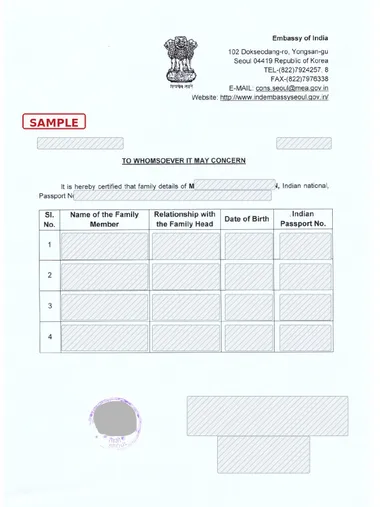
Case study — reinstating lapsed NHIS coverage with a Korea-issued FRC
One of our clients had family members who stayed in India for an extended period, which caused their Korean NHIS dependent coverage to lapse. To reinstate it, they:
- Applied for a fresh Family Relationship Certificate.
- Had the newly issued certificate apostilled by India’s Ministry of External Affairs.
- Had it delivered to South Korea.
- Got it translated into Korean and notarized, since their local NHIS branch specifically required notarization rather than an administrative agent’s translation certificate.
- Submitted the complete set to their local NHIS branch — the certificate was accepted, and their dependent coverage was reinstated.
This shows why the certificate needs to be freshly issued and freshly apostilled — not an old copy — when you’re using it to fix a lapsed registration, and why the Korean translation/notarization step isn’t optional for many NHIS branches. See our NHIS for Indian families guide for more scenarios like this one.
After you receive the FRC: apostille → translation → notarization → submission
Getting the certificate from ICAC is only step one. Before a Korean office will accept it, it needs to go through:
- MEA apostille (India). Neither ICAC nor the Embassy apostilles the FRC — this is a separate step handled by India’s Ministry of External Affairs. Since India and South Korea are both Apostille Convention members, this apostille is accepted directly in Korea without further embassy legalization. See our apostille process in India guide.
- Korean translation. Once apostilled, the certificate needs a Korean translation — see our certified translation guide for the difference between a simple certification, a Public Certificate of Translation, and a notarized translation.
- Notarization (if your receiving office requires it). Some offices — including some NHIS branches — specifically require the translation to be notarized by a Korean notary public, rather than certified only by a licensed translation administrative agent. Confirm this with your specific office before commissioning the translation. See our Korean notary public guide.
- Submission. Bring the original certificate, the apostille, and the notarized/certified Korean translation to the relevant office — typically your local NHIS branch, or whichever office requested the document.

We apostille Family Relationship Certificates and marriage certificates remotely from a scan and courier the original to South Korea. Message us on Contact and we’ll confirm the route, price, and ETA.
Common mistakes to avoid
- Assuming ICAC or the Embassy apostilles the certificate — neither does.
- Submitting an old certificate with an old apostille to fix a lapsed NHIS registration, instead of getting both freshly issued.
- Skipping the notarization step because a translation certificate was accepted elsewhere — requirements can differ by NHIS branch.
- Not checking whether your spouse’s name mismatch requires an apostilled marriage certificate before you book your ICAC appointment.
- Paying by card without accounting for the processing surcharge.
Frequently asked questions
South Korea FRC FAQs
Who can apply for a Family Relationship Certificate through ICAC Seoul?
Indian nationals residing in South Korea with a valid visa or residence permit (ARC), and — for family-tie purposes — Korean nationals with family ties to Indian citizens.
Does ICAC or the Embassy apostille the FRC for me?
No. Neither apostilles the certificate. Apostille is a separate step handled in India by the Ministry of External Affairs (MEA), after the certificate is issued in Seoul.
How long does it take to get an FRC through ICAC Seoul?
Generally 7-10 business days after submission of complete documentation, though this can vary — confirm the current estimate when you book your appointment.
Do I need to visit ICAC in person?
Yes, for document submission — personal attendance is required for the applicant. Collection afterward can be done in person or through an authorized representative carrying a signed letter and valid ID.
Why does NHIS specifically ask for a Family Relationship Certificate instead of a marriage certificate?
NHIS may request an FRC when it needs to see your full family structure clearly — for example when multiple dependents are involved, or a marriage certificate alone doesn't fully establish the relationships NHIS needs to see. See our full NHIS guide for Indian families (linked below) for when each document applies.
My family's NHIS coverage lapsed after a long stay in India — will an old FRC work to reinstate it?
Generally no — NHIS will usually want a freshly issued certificate with a fresh apostille, not the one used in your original registration.
Does the Korean translation need to be notarized?
It depends on the receiving office. Some NHIS branches accept a Public Certificate of Translation from a licensed translation administrative agent; others specifically require notarization by a Korean notary public. Confirm with your local branch before commissioning the translation — see our certified translation guide (linked below).
Next step after receiving your FRC
Whether you’re applying for NHIS, a dependent visa, or a school admission, send us the complete scan and your recipient’s written requirement — we’ll confirm the apostille route before you courier anything.
Send your FRC scan from ICAC Seoul and get your route, price, and ETA the same day.
Customer Reviews
I required to apostille birth certificate and Family Relationship certificate for my kids' Permanent Residency Visa (F2) in South Korea. Verified Apostille Services provided good service. I am a happy customer. Documents were apostilled on August 19, 2026.
- Clear process
- Reliable international delivery
- Reasonable pricing
I needed apostilles on my family's Indian documents to complete some paperwork here in Madrid. The process was explained clearly from the start, and everything was couriered to Spain without any issues.
- Clear process
- Reliable international delivery
