
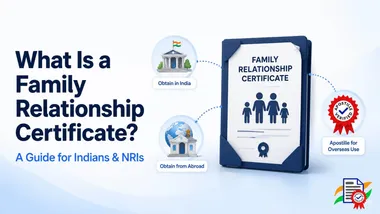
Short answer: A Family Relationship Certificate (FRC) — also called a Family Member Certificate — is an official Indian document proving how family members are related to each other. NRIs typically need one for dependent visas, health insurance or social security registration abroad, school admissions, inheritance claims, and similar official submissions where a marriage certificate alone doesn’t clearly show the full family structure. You can get one (1) through the Indian Embassy, Consulate, or High Commission covering your country of residence, or (2) through your home state’s Revenue Department in India, issued by a Tahsildar or equivalent local officer. Whichever route you use, the certificate must be apostilled afterward before most foreign authorities will accept it.
What is a Family Relationship Certificate?
A Family Relationship Certificate lists an applicant’s family members — typically spouse, children, and parents — and states how each one is related to the applicant. It’s a broader document than a marriage certificate, which only proves the relationship between spouses. Recipients ask for an FRC specifically when they need to see the complete family structure in one document rather than piecing it together from separate certificates.
Depending on the state or issuing authority, you may see this called a Family Member Certificate, Family Relation Certificate, or (in some states, such as Telangana’s newer digital version) a Family Register Certificate. The underlying purpose is the same across names.
Marriage certificate vs. Family Relationship / Family Member Certificate
These two documents overlap but answer different questions, and mixing them up is one of the most common reasons a submission gets bounced back.
- A marriage certificate is a point-in-time record — it confirms that a marriage was registered on a specific date. It doesn’t say anything about your family’s situation today.
- A Family Relationship Certificate (or Family Member/Family Register Certificate) is closer to a current-status snapshot. Because it’s freshly issued for each request, it can show:
- that the marriage is still valid as of the issue date (not annulled, dissolved, or otherwise ended);
- new family members who weren’t on record before — a child born after the marriage certificate was issued, for instance;
- each family member’s current status — nationality, and for some states, details like age or address as they stand today, not as they stood on the marriage date.
This is exactly why a recipient like NHIS in Korea, or an immigration office elsewhere, sometimes insists on an FRC even when you already have an apostilled marriage certificate: they’re not just asking “did this marriage happen,” they’re asking “is this still your family, right now.” If your situation has changed since your marriage certificate was issued — a new child, a change in someone’s nationality, a marriage that’s since ended — a marriage certificate alone won’t reflect that, and this is exactly the situation an FRC is designed to cover.
Why NRIs commonly need an FRC
- Dependent visas or residency permits — proving a spouse, child, or parent’s relationship to the primary applicant.
- Health insurance or social security registration abroad — some national schemes ask for a full family structure rather than a marriage certificate alone. (If you’re in South Korea, see our Korea-specific FRC guide, which covers this in detail for NHIS.)
- School or university admissions for a child, where the institution wants to confirm the parent-child relationship.
- Inheritance or succession matters, where multiple heirs’ relationships to the deceased need to be established.
- Banking, property, or other legal matters where a single document showing the family tree is more convenient than several separate certificates.
Always confirm with your specific recipient whether they need an FRC, a marriage certificate, a birth certificate, or some combination — don’t assume based on what worked for someone else’s case.
Step by step: how to get your FRC
Whichever route you use, getting an FRC follows the same basic shape:
- Confirm exactly what the recipient needs — which family members must be listed, and whether an apostille or translation is required.
- Choose your route — apply through the Indian Embassy/Consulate/High Commission covering your country of residence, or through your home state’s Revenue Department in India (directly, or via a family member there).
- Gather your documents — ID proof, address proof, birth/marriage certificates for the family members being listed, an affidavit where required, and passport-size photographs.
- Submit the application — file online or in person, depending on what your mission or state offers, and pay the applicable fee.
- Collect the certificate — processing commonly takes anywhere from a couple of days to about two weeks, depending on the mission or state.
- Get it apostilled by India’s MEA — the certificate must be apostilled before most foreign authorities will accept it.
The two sections below walk through step 2 — choosing your route — in more detail.
How to get a Family Relationship Certificate: two routes
Route 1 — Through the Indian Embassy, Consulate, or High Commission abroad
If you’re based outside India, the Indian mission covering your country or region typically offers a Family Relationship Certificate service, either directly or through an outsourced consular services partner. The exact application steps, document checklist, and fee vary by mission — for a fully worked example, see our step-by-step guide for Indians in South Korea, who apply through the India Consular Application Centre (ICAC) in Seoul.
This route is usually more convenient when you’re already abroad and want everything processed locally, without depending on a family member in India to apply for you.
Route 2 — Through your home state’s Revenue Department in India
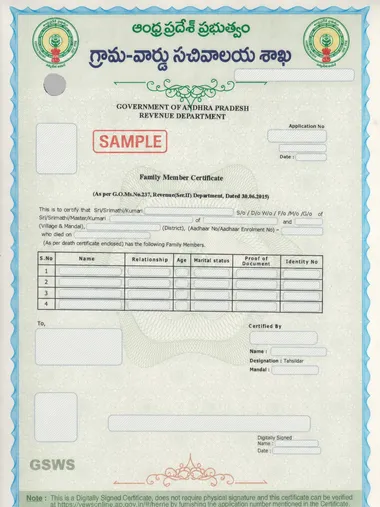
An FRC (or Family Member Certificate) can be issued by the Tahsildar, Mandal Revenue Officer, or equivalent local revenue authority with jurisdiction over your family’s registered address in India. This is generally the most direct route if family members are already in India and able to apply, or if your state offers an online application that doesn’t require an in-person visit at all.
Example — Andhra Pradesh: residents can apply for a Family Member Certificate through the state’s citizen services portal (apseva.ap.gov.in), under Revenue Department services, without a physical visit required for straightforward cases.
Example — Telangana: the state’s newer Family Register Certificate is a single sheet listing every household member, their relationship to the head of the family, age, date of birth, gender, and Aadhaar number, digitally signed by the Tahsildar. It’s applied for through MeeSeva and commonly issued within about 2 working days.
Processes, portals, and fees differ meaningfully by state, so check your specific state’s current e-district or citizen-services portal rather than assuming a uniform national process.
Which route is faster?
There’s no universal answer — it depends on whether your state offers a fast online option, whether you have a family member in India able to apply on your behalf, and how quickly your local Indian mission processes the certificate. If timing matters, it’s worth checking both routes’ current turnaround before committing to one.
Documents commonly required
Exact requirements vary by state and mission, but you’ll typically need:
- Identity proof for the applicant and family members being listed (Aadhaar, passport, PAN, or Voter ID)
- Address proof tying the applicant to the jurisdiction (ration card, utility bill, or similar)
- Birth and/or marriage certificates establishing the relationships being certified
- An affidavit, in some states, declaring the family relationships being listed
- Passport-size photographs
- For applications through an Indian mission abroad: your passport, visa/residence permit, and often your marriage certificate if a spouse is being listed
Apostille is mandatory before use abroad
Whether you get your Family Relationship Certificate through an Indian mission abroad or a state Revenue Department in India, the certificate needs to be apostilled by India’s Ministry of External Affairs (MEA) before most Hague Convention countries’ authorities will accept it — see our apostille process in India guide. This applies every time you get a new version of the certificate — an apostille on an old certificate doesn’t cover a freshly issued one.

We apostille Family Relationship Certificates and marriage certificates remotely from a scan and courier the original worldwide. Message us on Contact and we’ll confirm the route, price, and ETA.
Common mistakes to avoid
- Assuming a marriage certificate alone will satisfy a recipient who specifically asked for a Family Relationship Certificate.
- Applying through the wrong state’s Revenue Department — jurisdiction follows your family’s registered address, not your current location.
- Assuming a consular officer’s signature abroad replaces the apostille requirement.
- Submitting an old certificate with an old apostille when the recipient wants a freshly issued, freshly apostilled document.
- Not confirming translation requirements upfront if your destination country doesn’t use English.
Frequently asked questions
Family Relationship Certificate FAQs
Is a Family Relationship Certificate the same as a marriage certificate?
No. A marriage certificate proves the relationship between spouses only. A Family Relationship Certificate (also called a Family Member Certificate) is broader — it lists multiple family members and how each is related to the applicant, which is why some recipients specifically ask for it instead of a marriage certificate.
Is the certificate the same across every Indian state?
No — it's issued by each state's own revenue authority, commonly the Tahsildar, Mandal Revenue Officer, or Village Administrative Officer, so the exact name, portal, fee, and turnaround vary by state. Confirm your specific state's current process before applying.
Can I apply while I'm abroad, or does a family member have to apply in India?
Both are possible. Many states now offer online applications that a family member in India can file on your behalf, and several Indian missions abroad also issue the certificate directly to applicants living in their jurisdiction. Check which option is faster given where your family members currently are.
Do I still need an apostille if an Indian consular officer abroad signed the certificate?
Yes. A consular officer's signature abroad doesn't replace the apostille requirement — the certificate still needs to go through MEA apostille before most Hague Convention countries' authorities will accept it.
How long does it take to get a Family Relationship Certificate?
It varies by state and route — some state portals process it in as little as 2 working days, while others take up to 2 weeks. Missions abroad commonly take about a week to ten days. Always confirm the current timeline with the specific office you're applying through.
How long is a Family Relationship Certificate valid for?
The certificate itself doesn't carry a fixed expiry, but most recipients — including foreign government bodies — want one issued recently, often within the last 3–6 months, and with a fresh apostille rather than an old one reused from a previous submission.
Next steps with VerifiedApostille
- How Indians in South Korea Get a Family Relationship Certificate
- Family Relationship Certificate Apostille Service
- Apostille Process in India
Send a scan of your Family Relationship Certificate and get your route, price, and ETA the same day.
Customer Reviews
I required to apostille birth certificate and Family Relationship certificate for my kids' Permanent Residency Visa (F2) in South Korea. Verified Apostille Services provided good service. I am a happy customer. Documents were apostilled on August 19, 2026.
- Clear process
- Reliable international delivery
- Reasonable pricing
I needed apostilles on my family's Indian documents to complete some paperwork here in Madrid. The process was explained clearly from the start, and everything was couriered to Spain without any issues.
- Clear process
- Reliable international delivery
