


Short answer: In South Korea, you don’t need a special “foreigner’s notary.” Any licensed Korean notary public (공증인) can notarize your document, and many are lawyers who can assist you in English. Notary offices are commonly found near district judiciary offices — district courts and prosecutors’ offices — not just city hall. In practice, most offices require your document to be translated into Korean first, even for signature witnessing, so budget for translation before you approach a notary, not as an afterthought. For anything that needs the content certified (like a translation), you’ll need a notarized translation, not just a plain notary stamp.
1) What a Korean notary can and can’t do for your document
A Korean notary’s main jobs are:
- Witnessing a signature — confirming that you personally signed a document in front of them.
- Certifying a translation — confirming that a named translator signed a translation and it matches the original.
- Certifying a copy — confirming a photocopy matches an original.
One important thing to know: very few notary offices will witness a signature on an English-language document without a Korean translation attached first. Even for signature witnessing, most offices expect the document to be translated into Korean before you come in, so the notary can confirm you understand what you’re signing. Treat translation as a mandatory first step, not an optional extra — see our guide on certified English–Korean translation in South Korea for how that works.

Most translation providers are used to this two-step process and can arrange the notary step for you, or refer you to one they work with — it’s worth asking your translator directly rather than searching for a notary separately.
What a Korean notary does not do: they don’t verify that the content of your document is legally correct, and they can’t issue an apostille themselves — that comes from the Ministry of Foreign Affairs or Ministry of Justice afterward. See how to apostille a document in South Korea for that separate step.
2) Where to find a notary public in Korea
Notary offices (공증사무소) are usually run by licensed lawyers and are commonly clustered:
- Near district judiciary offices — district courts (지방법원) and prosecutors’ offices (검찰청) — since many notaries are lawyers whose practice is based there
- Also near district (gu) offices and city hall buildings
- Inside or next to law firms, especially in Seoul’s Gangnam, Jongno, and Seocho districts
- Search “공증” (notarization) or “번역공증” (translation notarization) plus your city name on Naver Map or Kakao Map — the most reliable way to find one near you, since there isn’t one central government directory for private notary offices
Many of these lawyer-notaries can assist you directly in English, but exactly what they can do — and what extra steps are needed — depends on your specific document, so call ahead to confirm before you go.
If you’re not in Korea, most Korean law firms that do notarization also offer a remote process: you send scanned documents, they prepare the notarial certificate, and courier the original back to you.
3) What to bring
- Your passport or Alien Registration Card (ARC)
- The original document (or a clear copy, if you’re only certifying a copy)
- If someone else is signing on your behalf: a power of attorney
4) How much it costs
Notary fees in Korea are fixed by a set schedule — prices are the same across reputable offices for the same service. As a general guide:
| Service | Typical fee |
|---|---|
| Translation notarization | ₩25,000 + ₩2,000 repository charge (₩27,000 total) |
| Signature notarization | ₩57,000 |
Prices can vary a little by document type and length, so treat these as a general guide rather than a guaranteed quote. If you have several documents to notarize at once, it’s worth asking whether a concession is possible — but in most cases offices won’t reduce the fixed price, so don’t count on a discount.
5) What a notarial certificate looks like
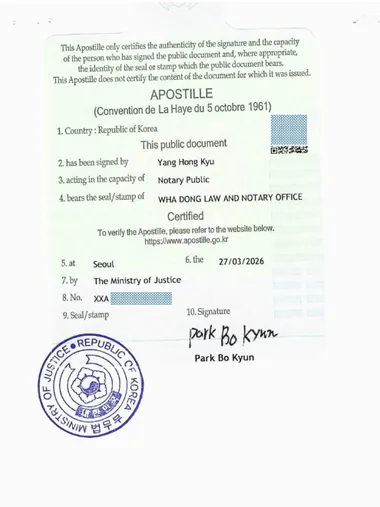
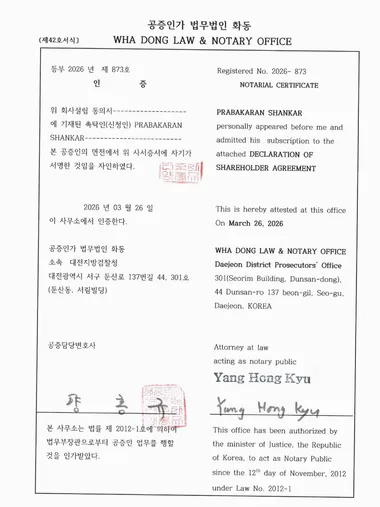
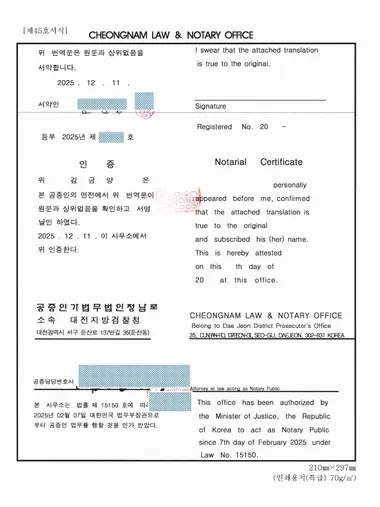
To help you recognize what you’re getting, here are examples of real Korean notarial certificates (personal details redacted):
What to check before collecting your notarized document
A Korean notary doesn’t alter or write on your original document itself. Instead, the certificate they issue separately references your name and the name/type of the document being notarized. Before you leave the notary office, check that:
- For a translation notarization: the certificate clearly shows the translator’s name, the translator’s signature, and a serial number (등록번호) — all three should be present, not just a stamp.
- For a signature notarization: the certificate shows a serial number, the date, and the name of the specific document you signed.
- The split stamp (간인): notaries typically stamp half on your main document and the other half on their office’s reference copy, so the two halves can be matched up later if there’s ever a dispute about authenticity. Make sure this half-stamp is visible on your copy.
- Retention: by rule, the law office must keep their reference copy on file for at least 9–12 months, so you can go back within that window if you ever need to verify it.
If any of these details are missing on the certificate you’re handed, ask the office to correct it before you leave — it’s much harder to fix later.
6) When you might not need a Korean notary at all
If your document was issued outside Korea — for example, in India — and you just need it recognized in Korea, the usual path is to get it apostilled in the country it came from, not notarized in Korea. See the apostille process in India for that route. Korean notarization is mainly relevant when:
- The document was created or will be used inside Korea, or
- A Korean authority specifically asks for a Korean-notarized translation — this is common for NHIS health insurance submissions. See our guide on NHIS for Indian families in Korea.
Frequently asked questions
Korean Notary Public FAQs
Do I need a Korean notary if my document is already apostilled in my home country?
No. An apostille from your home country is usually accepted as-is by Korean authorities, without any extra Korean notarization, unless the receiving office specifically asks for a Korean translation to be notarized.
Can a Korean notary notarize a document in English?
In most cases, no — not directly. Almost all notary offices ask for a Korean translation first, even for simple signature witnessing, so the notary can confirm you understand the document. Plan for translation as a required first step, and ask your translator to help arrange the notary appointment.
Where are notary offices usually located in Korea?
Most are run by lawyers and cluster near district judiciary offices — district courts and prosecutors' offices — as well as near district (gu) offices and city hall. Searching 공증 or 번역공증 plus your city name on Naver Map or Kakao Map is the fastest way to find one nearby.
How much does it cost to notarize a document in Korea?
Fees follow a fixed schedule and don't vary much by office: translation notarization runs around ₩27,000 total (₩25,000 plus a ₩2,000 repository charge), and signature notarization runs around ₩57,000. These are fixed, not negotiable, even for bulk documents.
Is a notary the same as an apostille in Korea?
No. A notary certifies a signature, translation, or copy. An apostille is a separate government certificate confirming the notary's own seal and signature are genuine, for use abroad.
What is the split stamp (간인) on a Korean notarial certificate?
It's a stamp applied half on your document and half on the notary office's own reference copy. If the two halves are ever placed together, they should line up exactly — this lets anyone verify later that your copy matches the office's file.
How long does a Korean law office keep a copy of my notarized document?
By rule, at least 9 to 12 months. If you lose your copy or need to verify it later, you can go back to the same office within that window to confirm it.
Can I get a document notarized in Korea without visiting in person?
Often yes, through a law office that handles remote or courier-based notarization — you'll usually still need to verify your identity, sometimes via video call.
See also: how apostille works in South Korea, which is a separate step from notarization.
Next steps with VerifiedApostille
If your document was issued in India and just needs to be recognized in Korea, you don’t need a Korean notary at all — it needs an MEA apostille from India instead:
- Apostille Process in India — Meaning, Process & MEA Certificate Guide
- Personal Document Apostille — Birth, Marriage, PCC & Affidavits
- Marriage Certificate Apostille
We apostille Indian documents remotely and courier the originals worldwide, including to South Korea. Start a chat from Contact and we’ll confirm the exact route, price, and ETA.
