
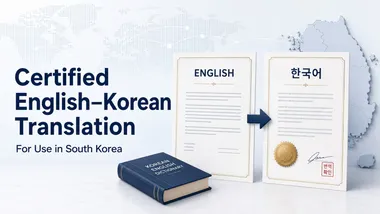
Short answer: Korea has two genuinely different ways to get a translation officially recognized, and it’s important not to confuse them. A licensed foreign language translation administrative agent (외국어번역행정사) — qualified under the Administrative Agent Act (행정사법) — can issue a Public Certificate of Translation (공인번역확인증명서), a signed, sealed certificate confirming the translation matches the original. This is a real, verifiable professional certification, but it is not a Ministry of Justice qualification and not notarization — the agent is not a notary. Some institutions, including some NHIS branches, specifically require notarization by a notary public instead, and will reject a translation that carries only the administrative agent’s certificate. Always confirm which one the receiving office actually wants before you pay for either.
1) What “certified translation” actually means in Korea
Korean offices generally accept a translation as “certified” or “official” through one of these routes:
- A Public Certificate of Translation (공인번역확인증명서) — issued by a licensed translation administrative agent. The certificate names the applicant, lists the exact documents covered, states the purpose of submission, and is signed and sealed by the agent, citing their license number and the legal basis (Administrative Agent Act, Article 5).
- A translator/agency certification statement — a simpler signed page from a translator or agency stating the translation is accurate and complete, without the formal licensed-agent certificate.
- Notarization — a Korean notary certifies that the named translator signed the translation in front of them (the notary vouches for the signature, not the accuracy of the translation).

The licensed administrative agent’s certificate is genuine and verifiable, but it is fundamentally different from notarization. Some institutions — including some NHIS branches — will reject a translation certified only by an administrative agent and specifically require full notarization instead. Don’t assume one substitutes for the other; check with the receiving office first.
Which route you need depends entirely on who’s asking for the document. A university admissions office might accept a simple certification statement, while NHIS, immigration, or embassy submissions vary by office — see our guide on NHIS for Indian families in Korea for how this plays out in practice.
2) The process, step by step
- Send the original document. A clear scan or photo is usually enough to get a quote and start work.
- Translation is done by a professional English–Korean translator (or Korean–English, depending on direction).
- Certification is attached. For a Public Certificate of Translation, a licensed agent issues a signed, sealed certificate listing your name, the documents covered, and the purpose of submission. For a simpler statement, it’s just a signed accuracy page.
- Notarization (if required instead of, or in addition to, the above). The translator signs in front of a Korean notary, who certifies the signature.
- Delivery. You receive a physical set (often needed for government submission) and/or a scanned PDF.
3) What’s on a Public Certificate of Translation
If you receive a licensed agent’s Public Certificate of Translation, it will typically show:
- Applicant details — your name (English and Korean) and date of birth.
- Document title — the exact document(s) covered.
- Purpose of submission — a short line stating this is for submission to an institution/agency.
- Certification statement — the licensed agent’s name, confirming they translated the document under their authority as a translation administrative agent.
- License/certificate number — a unique number tied to the agent’s license, plus the date of certification.
- Signature and official seal — the agent’s signature and a red official seal, plus a registration number issued under the Ministry of the Interior and Safety.
Before accepting the certificate, check that your name, the document title, and the purpose are all correct, and that the license number and seal are present.
4) What affects the cost
- Document type — a one-page certificate (birth, marriage, family relationship) is cheaper than a multi-page legal contract or academic transcript.
- Notarization or not — adding notarization increases the cost, since it involves a separate notary fee on top of translation.
- Turnaround time — rush service (same-day or next-day) usually costs more.
- Formatting — documents with tables, stamps, or seals that need to be described/replicated take more translator time.
| Item | Typical cost |
|---|---|
| Translation (per page, simple document) | ₩30,000 (before notarization) |
| Notarization of translation | ₩27,000 total (see our notary guide) |
If you have several pages or documents to translate at once, ask for a bulk discount — many agencies reduce the per-page rate for larger jobs, unlike notary fees, which are fixed. Because pricing varies by agency and document complexity, get a specific quote broken down into “translation” and “notarization” separately so you can compare providers fairly.
5) How to choose a translation service in South Korea
- Confirm they can provide both the translation and the notarization (or a partner notary), so you’re not coordinating two separate providers.
- Ask if they’ve handled the same type of document before — immigration offices, NHIS, and universities each have slightly different formatting expectations.
- If you’re outside Seoul, ask whether they handle everything remotely — most reputable services do, since Korea’s notary and translation network operates through mail and courier for out-of-town or overseas clients.
Frequently asked questions
Certified Translation in South Korea FAQs
Do certified translators in Korea need a special license?
For a Public Certificate of Translation (공인번역확인증명서), yes — the person issuing it must be a licensed foreign language translation administrative agent (외국어번역행정사), qualified under the Administrative Agent Act (행정사법), with a verifiable license number. This is not a Ministry of Justice qualification and the agent is not a notary. Simpler certification statements from translators or agencies don't require this license at all. Because some offices — including some NHIS branches — will reject a translation certified only by an administrative agent, confirm with the receiving office which one your situation needs before you pay.
How much does certified translation cost per page in Korea?
As a general starting point, expect around ₩30,000 per page for a short, simple document, before notarization. Longer or more complex documents cost more, and it's worth asking for a bulk discount for several pages or documents at once.
Is a certified translation the same as a notarized translation in Korea?
No. A simple certified translation has a signed accuracy statement from the translator/agency. A Public Certificate of Translation from a licensed administrative agent is a stronger, verifiable professional certification — but it is still not notarization, since the administrative agent is not a notary. A notarized translation additionally has a Korean notary confirming the translator's signature. Some Korean offices — including some NHIS branches — require notarization specifically and will reject the administrative agent's certificate as a substitute.
Can I translate my own document and just get it notarized?
Some smaller offices may accept a self-translation for simple purposes, but most government agencies (like NHIS or immigration) expect the translation to come from a professional translator or agency, not the applicant themselves.
Do I need the translation apostilled too?
Sometimes. If the translation itself needs to be recognized outside Korea — not just inside Korea — it may need to be notarized and then apostilled by MOFA. Check with the receiving authority on which version needs the apostille.
How fast can I get a certified translation in South Korea?
Simple, single-page documents can often be turned around in a few business days; always confirm timing upfront if you're on a visa or insurance deadline.
Related reading: Korean notary public for foreigners and how to apostille a document in South Korea.
Next steps with VerifiedApostille
- Korean Notary Public for Foreigners — Where to Go & Fees
- NHIS Health Insurance for Indian Families in Korea
- How Indians in South Korea Get a Family Relationship Certificate
If the document you’re translating is an Indian certificate that still needs an MEA apostille before it’s valid in Korea, see our apostille process guide or message us on Contact — we handle the India-side apostille remotely and courier the original to South Korea.
